Your concealer isn't the problem — where you put it is
Almost everyone applies it in the one place that makes tiredness more obvious, not less. Here is the shape that actually works.
 Danny Rose
Makeup artist · New York
Danny Rose
Makeup artist · New York
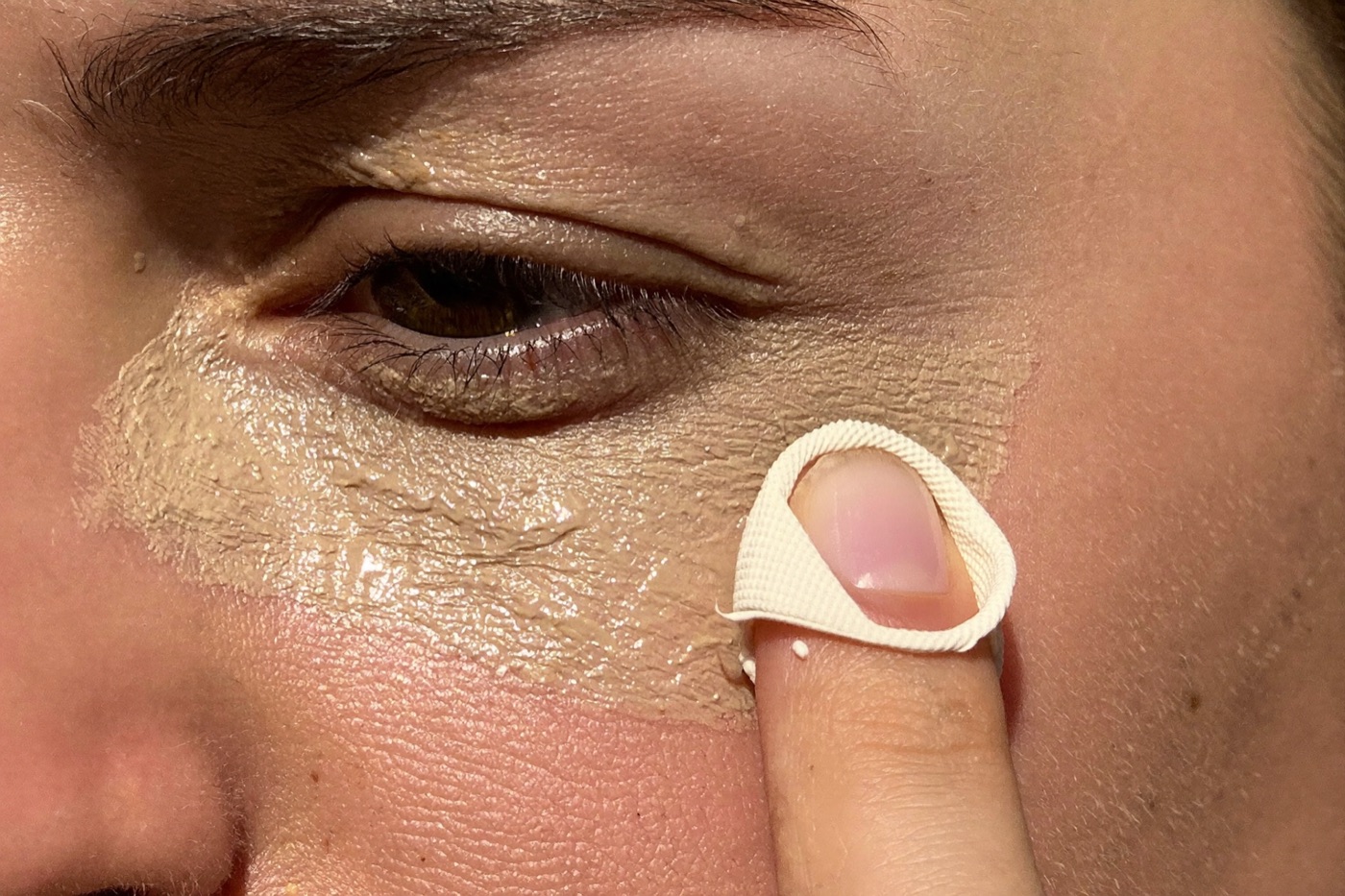
I have watched several hundred people do their own concealer, because I ask lesson clients to show me their normal routine before I say a single word. It is the most useful ninety seconds of the whole session.
Nearly all of them do the same thing. They squeeze the wand, draw a neat little arc directly along the dark crescent under the eye, and pat it in. Then they look at the mirror, decide it has not worked, and add more.
The product is almost never the problem. The shape is.
What that little arc is actually doing
The dark area under your eye is not flat and it is not on the surface. It is a hollow — the tear trough — and what you are seeing is mostly shadow, plus the vein color under skin that is thinner there than anywhere else on your face.
When you fill that hollow neatly with a lighter product, you have drawn a bright line along the bottom of a dent. You have not removed the dent. You have outlined it. And because the eye goes straight to the highest-contrast thing in a face, you have also told everyone exactly where to look.
Then the second thing happens. That hollow is where the skin creases when you smile, when you squint, when you talk. A stripe of product sitting in a crease will always find the crease again. By eleven in the morning it is a line, and by three it is a line with texture in it.
Concealer under the eye is not a paint job. It is a lighting job.
The shape that works instead
Forget the crescent. Think of an upside-down triangle.
The flat top of the triangle sits just under your lower lashes. The point comes down onto the top of your cheek, roughly in line with the outer edge of your nostril — a fair bit lower than feels sensible the first time you do it.
That does three things at once. It brings light onto the flat plane of the cheek, where light actually lands on a face. It pulls the eye downwards and outwards rather than into the hollow. And most of the product now sits on skin that does not fold every time you speak.
Here is the full sequence I use on clients:
- Skip primer here. Whatever moisturiser you use is enough. One thin layer, and let it settle for a minute so it is not still wet when the concealer lands.
- Draw the triangle. Three or four small dashes, not a stripe. Top edge under the lashes, point down onto the cheek.
- Blend from the outside in. Ring finger, or a small damp sponge, tapping — never dragging. Dragging moves product into the crease, which is the thing we are trying to avoid.
- Stop early. The instinct is to keep going until it disappears. Leave it looking very slightly there. It will settle in a few minutes.
- Powder only the point of the triangle. A tiny amount on a small brush, pressed rather than swept. The top edge, right under the lashes, gets nothing at all — that is where powder turns into a line.
Choosing the shade, briefly
One to two steps lighter than your foundation. Not four. A concealer that is dramatically lighter reads as a patch in any light that is not your bathroom mirror, and it is instantly recognisable in photographs.
If your under-eye is genuinely blue-toned, a shade with a peach or orange base underneath the concealer will do more than a lighter shade will. Blue and orange cancel; blue and white just give you pale blue.
When it still creases
Assuming the placement is now right, there are three usual culprits.
Too much product. By a distance the most common. Halve it. Then halve it again.
Too much powder, or powder in the wrong place. Powder along the top edge, right where the skin is thinnest and folds most, guarantees a line by lunchtime. Powder the point of the triangle and leave the rest.
A formula that never sets. Some very hydrating concealers are designed to stay moveable. On dry skin, wonderful. On anyone whose under-eye is already prone to movement, they will migrate all day regardless of technique.
And one that is not your fault at all: if the hollow is deep, no concealer will remove it, because you cannot paint away a shadow that is cast by bone structure. You can soften the edge. That is the honest ceiling, and anyone selling you past it is selling you something.
What this looks like on a real face
The thing that surprises people in lessons is how much less tired they look with less product placed better. I have had clients tell me I did something to their eyes when all I did was move the same concealer they already owned two centimetres south.
Try it tomorrow morning on one side only. Do your usual on the left, do the triangle on the right, then go and stand by a window. It is not subtle.
If you would rather have someone show you on your own face than read about it — that is what the one-to-one lesson is. Two hours, your own products, and you do the applying.
Or let me do it
Reading about it is
slower than a lesson.
Two hours at your table, with your own products, and you hold the brush. $350 — and you keep the notes.
Keep reading
More from the journal
Most brows only need brushing
Before you fill anything, brush your brows up and set them. For most of the faces I see, that is the whole job, and it takes thirty seconds.
Why your foundation gets darker by lunchtime
Oxidation is real, it is predictable, and it is almost never fixed by buying a lighter shade of the same bottle.

Cloud skin makeup: what it is and how to get it
Cloud skin is the soft-focus base replacing glass skin — velvety, not flat, not shiny. How I build it in five steps, and the two powders that do it best.