Nobody is one foundation shade, and that is why yours never quite matches
The shade that matches you in October is wrong in July, and the one that matches your cheek is wrong on your jaw. Two bottles, mixed, solves it for good.
 Danny Rose
Makeup artist · New York
Danny Rose
Makeup artist · New York
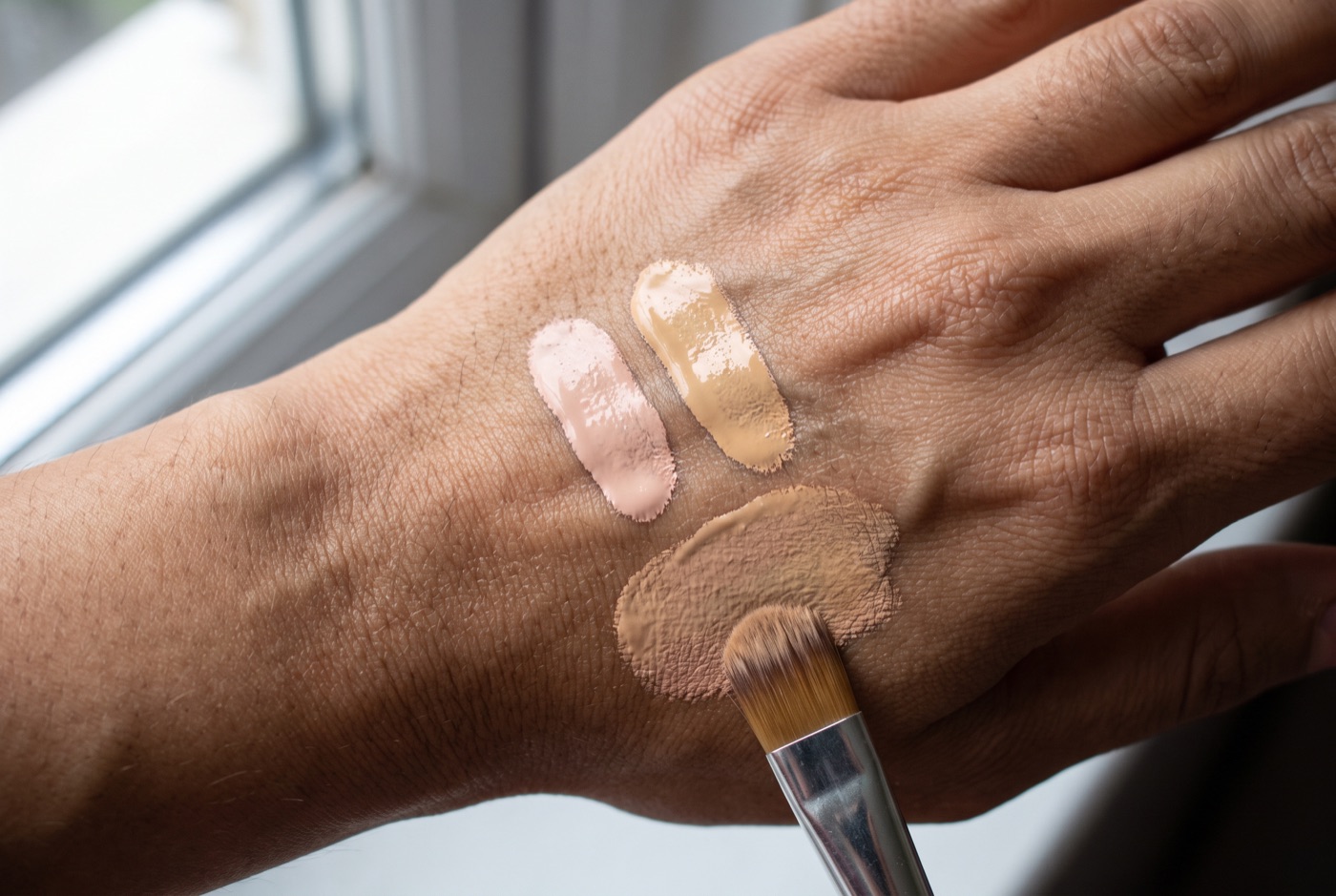
The most common thing I get handed at the start of a lesson is a foundation that is nearly right. Half a shade too pink, or too light around the jaw, or perfect in the bathroom and faintly orange in the office.
People assume they bought the wrong one. Usually they bought a perfectly good one, and the problem is the premise: that a single bottle can be exactly their color, all year, on every part of their face.
There isn't. There is no professional in this city working from one bottle per client, and there hasn't been for as long as the job has existed.
Why a single shade cannot work
Three reasons, and they stack.
Your face is not one color. For most people the centre — around the nose, the chin, between the brows — runs warmer and redder than the outer face, and the jaw runs slightly deeper than the cheek. Match to your cheek and the nose looks ruddy. Match to your nose and the rest of your face goes pale.
Your color moves through the year. A shade bought in August is close to useless by February, and the swing is bigger than people expect — usually a full shade. This is why the "perfect" bottle stops being perfect around month four.
Undertone and depth are two separate dials, and a shade ladder only gives you one. Finding your depth is easy. Finding your depth and your undertone in one bottle is luck — and if you are neutral, which a lot of people are, you are choosing between a pink one and a yellow one, neither of which is you.
Mixing solves all three at once, which is why every kit is built that way.
You are not looking for your shade. You are looking for the two shades it sits between. That is a much easier thing to find, and it is stable for years.
Buying the two
Buy the same formula twice. Different formulas mix badly — a silicone base and a water base will separate on the skin and pill within an hour.
Bottle one: half a shade lighter than your winter face. Bottle two: one to one and a half shades deeper than your summer face.
Undertone: if you know you skew warm, take the deeper one warm and the lighter one neutral. If you skew cool, the reverse. If you have no idea, take the 60-second undertone quiz first — or simply take both neutral — you can push warmth in later with bronzer, and a neutral pair mixes to something usable for almost anyone.
If two full-price bottles at once is too much, don't. Buy the shade you know is closest, then add the second as a mini, on the side you actually struggle with. Most people only need to correct in one direction.
The two I hand people most often
Since "buy the same formula twice" is easier said than shopped, here is what I actually recommend.
L'Oréal Paris True Match, around $13 a bottle. This is the one I point people to for their first pair, and not as a compromise. The shade ladder is wide and, more usefully, it is organised by undertone — cool, neutral, warm — which makes picking two bottles that sit either side of you a five-minute job instead of a gamble. The formula is thin, it mixes cleanly, and at twenty-six dollars for the pair you can afford to be wrong once.
Estée Lauder Double Wear, around $52. The event pair, and the one already living in my kit. It mixes beautifully, the shades stay true as they oxidize rather than drifting orange, and it survives a long day. Expensive twice over, so most people buy the second bottle as a mini and only in the direction they actually need.
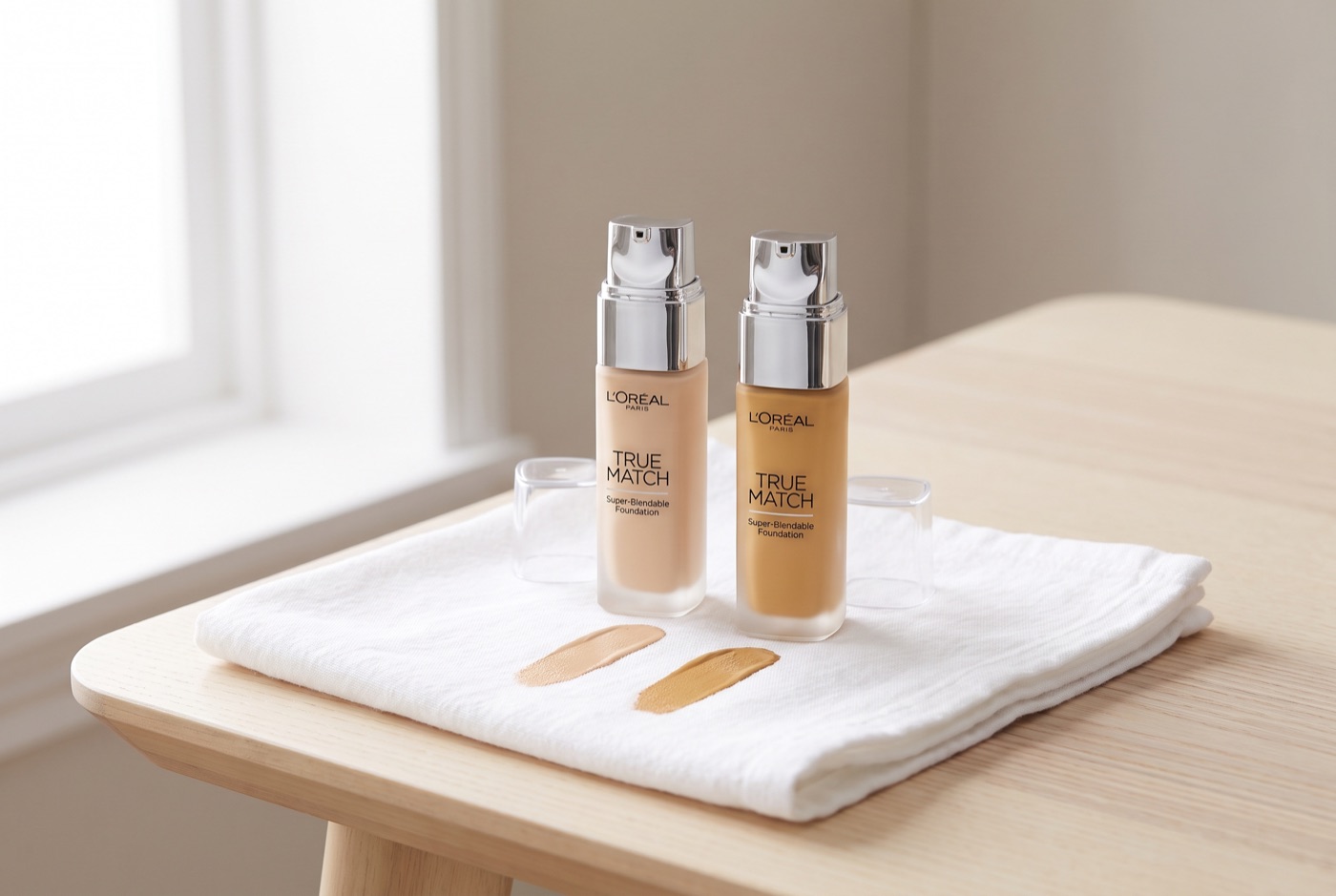
Making the shade, at the sink, in ten seconds
- Two drops on the back of your hand, side by side. Start roughly two parts of your closest shade to one part of the other.
- Mix with a flat brush or a finger until there is no streaking left. If you can see two colors, it will look like two colors on the face.
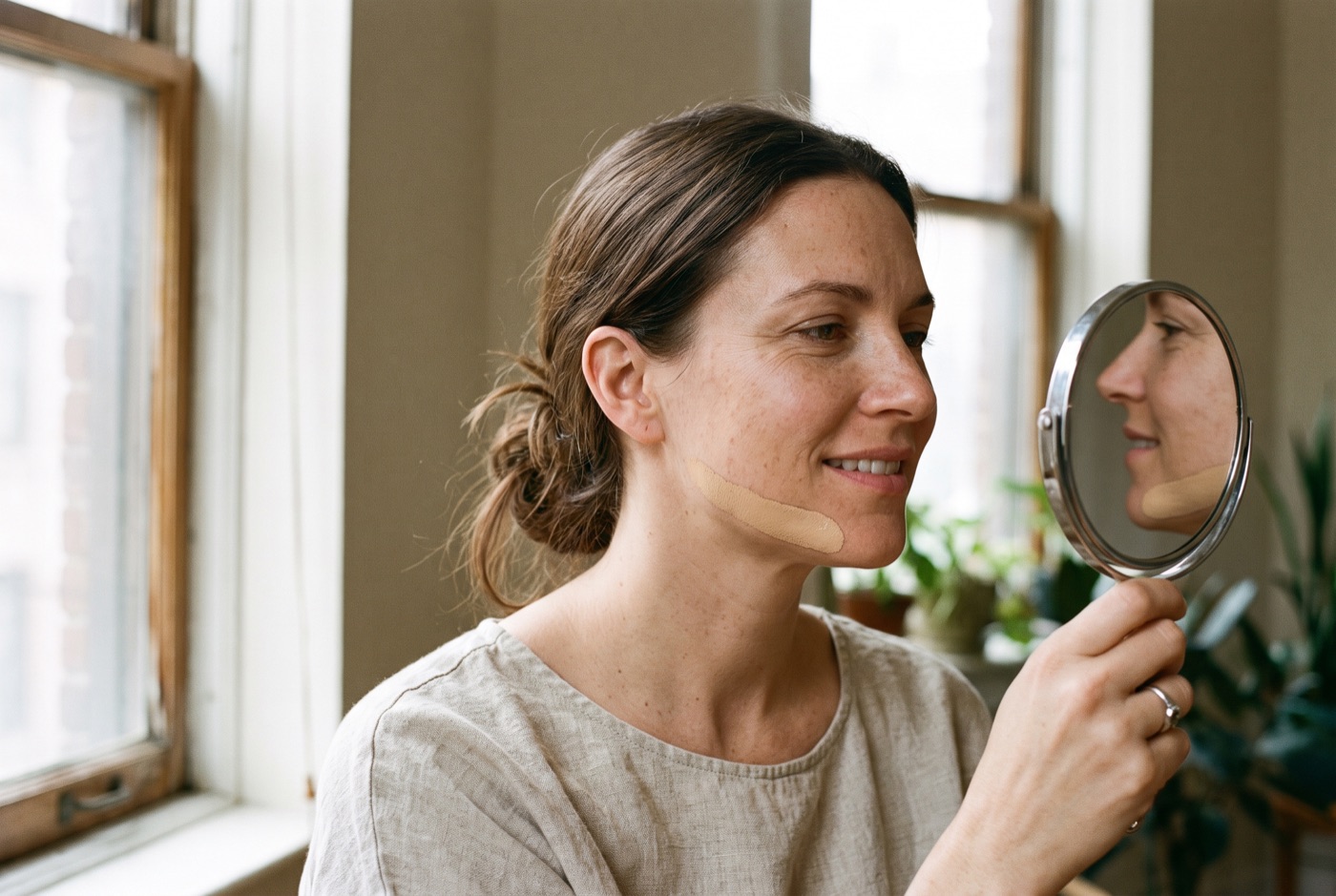
- Take it to your jaw, not your wrist. Wrist skin is not face skin and never has been. A stripe along the jaw, taken slightly down onto the neck.
- Walk to a window. Bathroom lighting is a liar in both directions. Daylight decides.
- The right mix disappears. Not "close" — gone. If you can find the edge of the stripe, adjust: too pale, add a drop of the deeper one; too heavy or orange, a drop of the lighter one. Two adjustments is normally all it takes.
- Then match your neck, not your face, if the two disagree. A face slightly deeper than a bare neck looks like makeup. A face that matches the neck reads as skin, every time.
- Note the ratio on a scrap of paper in your bag: "2 of the light, 1 of the deep". In three weeks you will not remember, and this is a thirty-second problem that otherwise becomes a monthly one.
The seasonal part, which is the real payoff
You change the ratio, not the bottles. That is the whole trick.
Deep winter, most people run about three parts light to one deep. High summer it flips to one to one, sometimes further. Spring and autumn are where the ratio earns its keep: you move a quarter of a shade a week instead of jumping a whole shade in one purchase and looking like a different person on a Monday.
The same two bottles carry you through the year, for two or three years, and you stop buying a new foundation every season — which is the part the shade-finder quizzes are not built to tell you.
When it still looks off
It matches, but it looks like a mask. That is coverage or amount, not shade. Thin it with a drop of moisturizer and apply less in the outer areas.
It matches in the morning and not by evening. Oxidation. Some formulas go deeper and warmer over a couple of hours, and the fix is to mix half a shade lighter than looks right and let it settle in — check the match at the ten-minute mark, not immediately.
Nothing matches around the mouth or the nose. That is usually redness rather than shade, and a foundation will not solve it. A little corrector under the base does more than a new bottle.
Two bottles are still not enough. If you have strong color variation across the face — noticeably deeper at the temples, lighter around the mouth — that is a two-mix face: a warmer mix for the centre panel, a slightly deeper one for the perimeter, blended where they meet. That is exactly what I do on set, and it is less fuss than it sounds.
Bring both bottles and I will find your ratio on your own jaw in about a minute — that is one of the things people get most out of a one-to-one lesson, and it is not a purchase, it is arithmetic. Or just ask me what to pair with what you have. I do not sell foundation. I have no stake in the answer.
Or let me do it
Reading about it is
slower than a lesson.
Two hours at your table, with your own products, and you hold the brush. $350 — and you keep the notes.
Keep reading
More from the journal
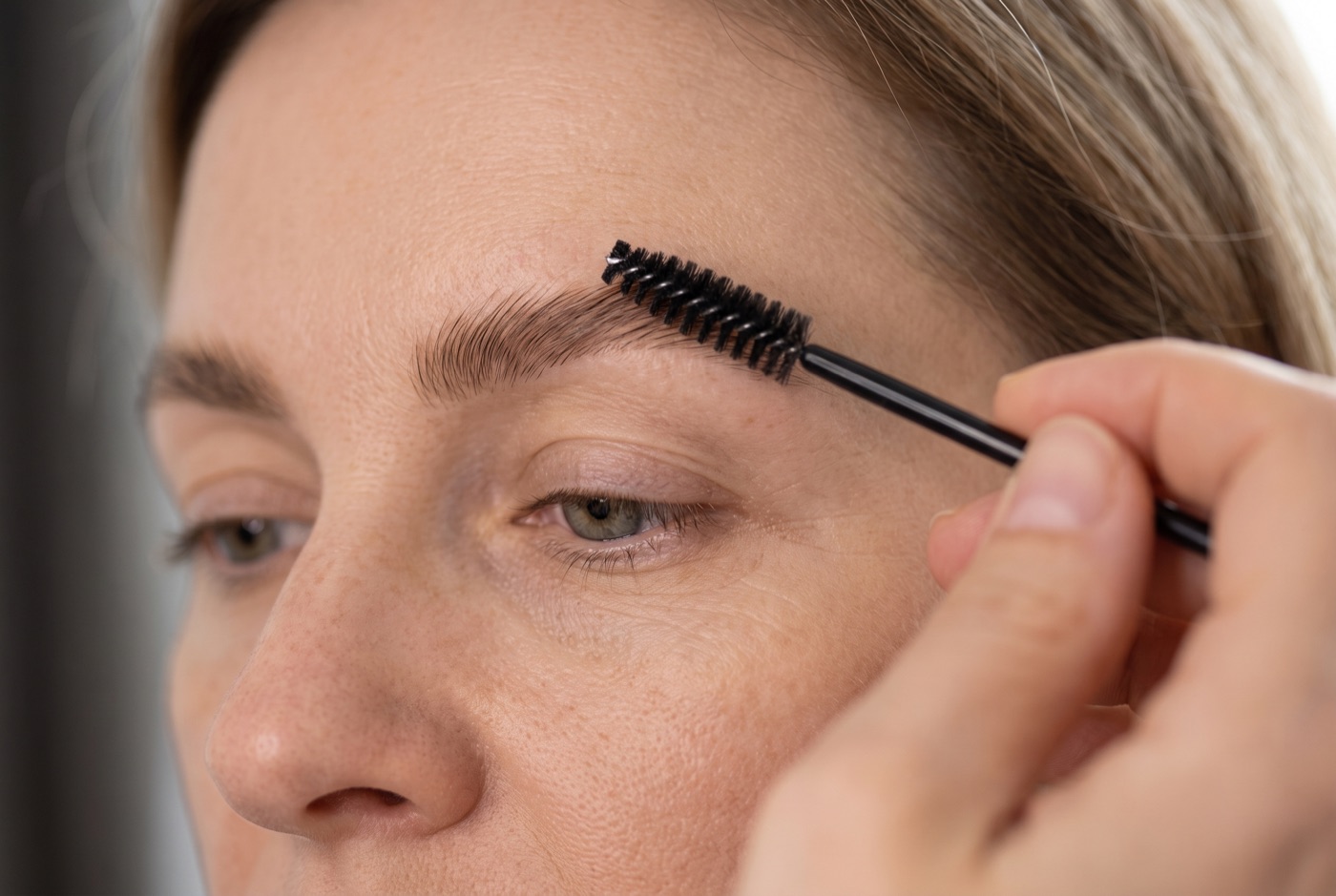
Most brows only need brushing
Before you fill anything, brush your brows up and set them. For most of the faces I see, that is the whole job, and it takes thirty seconds.
Why your foundation gets darker by lunchtime
Oxidation is real, it is predictable, and it is almost never fixed by buying a lighter shade of the same bottle.

Cloud skin makeup: what it is and how to get it
Cloud skin is the soft-focus base replacing glass skin — velvety, not flat, not shiny. How I build it in five steps, and the two powders that do it best.